Digital Growth Opportunities for Industrial Businesses in Erskine Park
A practical guide to the digital growth and search visibility opportunities available to established industrial businesses operating in Erskine Park, Western Sydney.
Erskine Park has quietly become one of the most important industrial precincts in Western Sydney. Its estates house manufacturers, distributors, logistics operators and product suppliers who serve customers across Sydney and the eastern seaboard. Yet many of these established businesses generate the majority of their enquiries through relationships, referrals and repeat trade rather than through online discovery. That approach has served them well for years, but it quietly leaves a significant amount of demand on the table, particularly as buyers increasingly begin their supplier research online before they ever pick up the phone.
This guide looks at the digital growth opportunities specifically available to industrial businesses in Erskine Park: where the demand sits, why so much of it goes uncaptured, and how a considered approach to search visibility can turn an under-used website into a dependable source of qualified commercial enquiries. The focus throughout is practical rather than theoretical, because established industrial businesses rarely need more marketing noise. They need a clearer path from online discovery to genuine enquiry.
Why location still matters for industrial search
There is a common assumption that because industrial businesses sell across wide geographies, local relevance no longer counts. In practice, the opposite is often true. Buyers frequently search for suppliers with reference to proximity, delivery radius, or the industrial corridor they operate within. A procurement manager sourcing a fabricator, a distributor or a specialised product supplier will often prefer a business that can service Western Sydney reliably, and location signals help both search engines and AI systems understand who fits that need.
Erskine Park sits within a dense logistics and manufacturing network, close to major transport routes and surrounded by complementary industrial businesses. That context is commercially meaningful. When a buyer is weighing lead times, freight costs and the practicality of site visits, a supplier's regional position becomes part of the decision. A website that communicates this clearly is easier for both people and machines to trust.
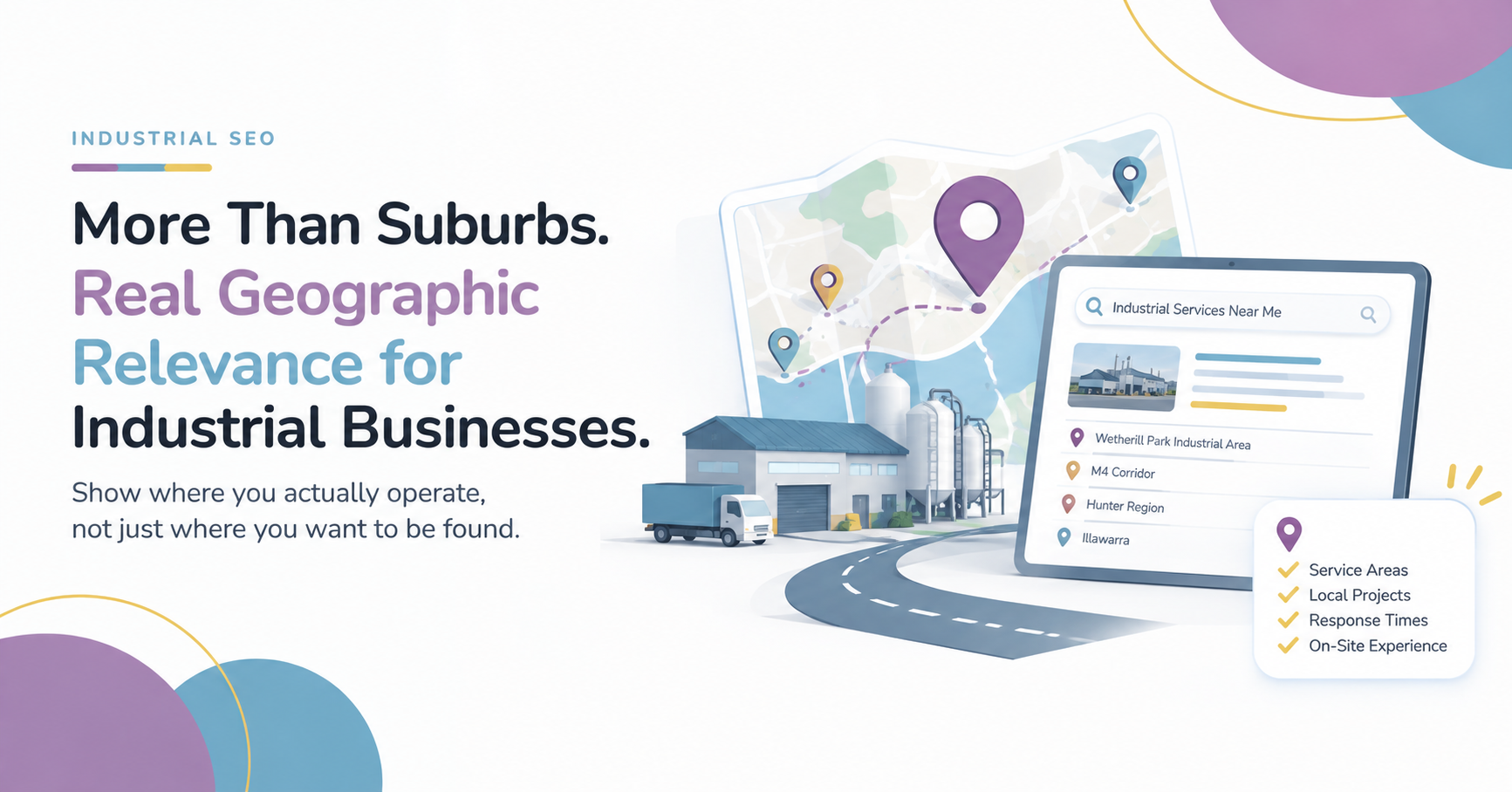
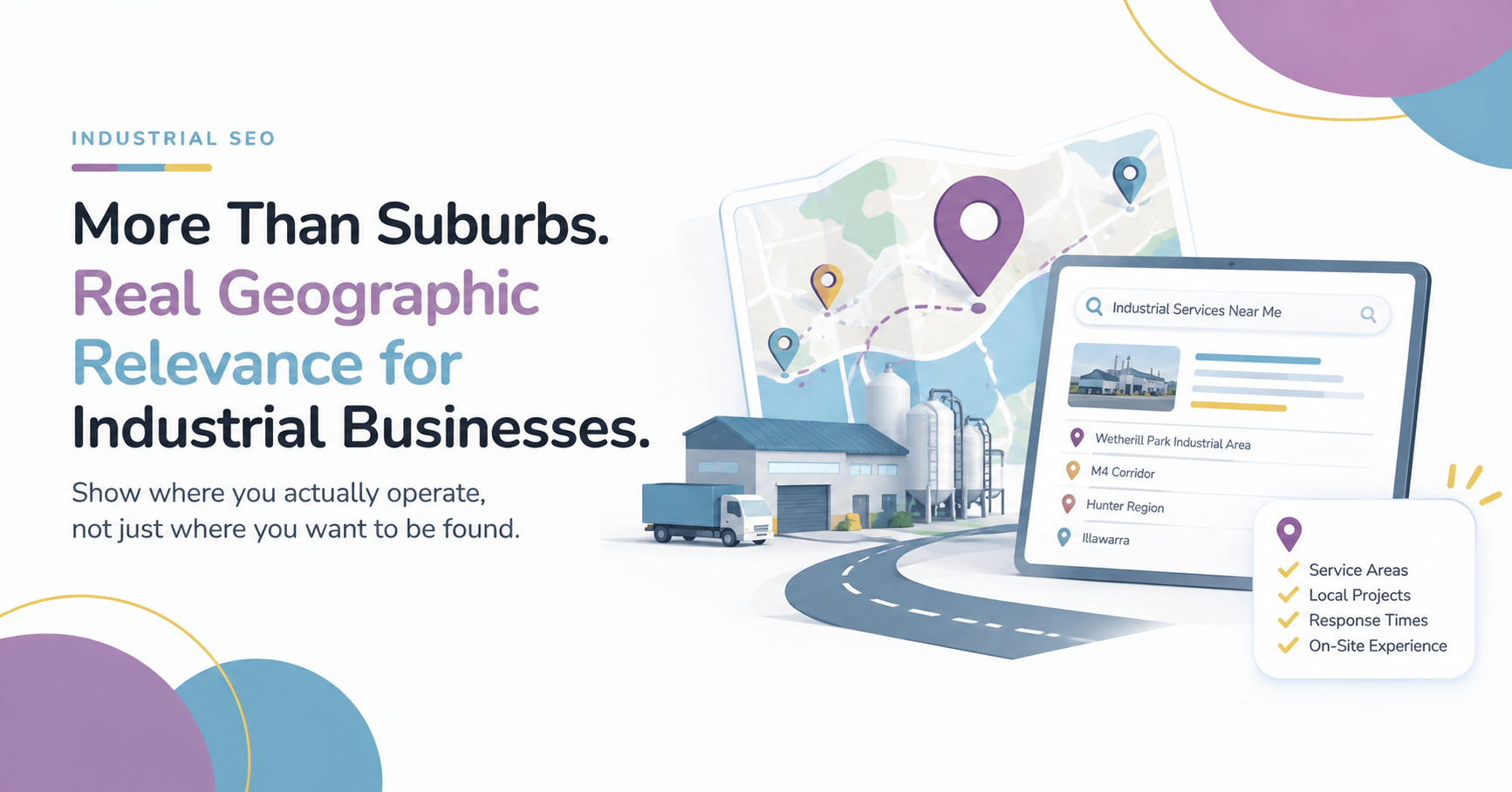
The mistake many businesses make is treating location as a single suburb page bolted onto the website. Genuine geographic relevance is built through content that reflects the industries served, the logistics reality of the region, and the customers a business actually works with. Our thinking on building genuine geographic relevance for industrial businesses explains why this matters far more than a template suburb landing page, and how thin location pages can actually undermine credibility rather than build it.
Understanding the demand around Erskine Park
The industrial economy of Western Sydney generates a substantial volume of commercial search activity, from early procurement research through to the comparison of suppliers, capabilities and product ranges. Much of this demand is non-branded: buyers looking for a capability or a product rather than a company they already know by name. Businesses that appear online only for their own name are effectively invisible to this earlier and larger pool of demand.
This matters because the earliest stage of a buyer's journey is often where suppliers are shortlisted. If a business is not present when a buyer is researching options, it may never make the consideration set, regardless of how strong its actual capability is. The enquiries that arrive by referral are valuable, but they represent only the portion of demand that already knows the business exists. The larger, unseen portion is where growth typically hides.
Establishing a clear picture of the search landscape in the region is the first step. The digital search benchmark for Western Sydney's industrial economy provides useful context on how this demand behaves and where established businesses tend to lose ground to less experienced but more visible competitors. Understanding that landscape helps a business decide where its effort will produce the greatest commercial return.
Measuring what actually matters
One of the reasons industrial businesses undervalue their websites is that they measure the wrong things. Total visits, session duration, bounce rates and similar vanity metrics say very little about commercial performance. A far more useful question is whether the website is producing qualified enquiries from the kinds of buyers a business genuinely wants to work with, and whether those enquiries are improving over time.
An industrial supplier might receive fewer than a dozen enquiries a month from its website, yet each one could represent a substantial order or a long-term supply relationship. In that context, a small improvement in enquiry quality is worth far more than a large increase in undifferentiated traffic. Measurement should reflect that reality, tracking the source and quality of enquiries rather than counting clicks.
This is complicated by the rise of answers delivered directly in search results and AI tools, where a buyer may learn about a business without ever clicking through to the website. Understanding the zero-click problem and what Western Sydney businesses should measure beyond website visits helps reframe success around influence and enquiry quality rather than raw traffic figures that no longer tell the whole story.
Being found, ranked and recommended
Digital visibility is not a single achievement but a progression. A page can be indexed without ever ranking, and it can rank respectably without being the source an AI system chooses to cite or recommend. Each stage requires different signals and a different standard of content quality. For an Erskine Park business, the goal is not simply to appear somewhere in search results, but to become the supplier that both systems and buyers treat as a credible, obvious answer.
This progression has become more important as AI-driven answers increasingly summarise and recommend businesses directly. Being recommended requires clarity about what a business does, evidence that it does it well, and content structured so that machines can understand and reuse it. Many established industrial businesses already hold this expertise; the gap is that it lives in the heads of their people or in PDF brochures rather than in accessible web content.
The distinction between being indexed, being ranked and being recommended is worth understanding in detail, because it shapes where effort should be focused. For most established industrial businesses in Erskine Park, the biggest opportunity lies in moving from merely present to genuinely recommended, which is where the highest-value discovery increasingly happens.
Want to know how your website really stacks up?
Run our free Website & AI Visibility Audit to see how you rank on Google — and in AI search results.
- Free, no-obligation report
- Delivered in minutes
- See exactly what to fix first
Growth that reflects commercial value
It is entirely possible to grow website traffic without growing the business. Attracting visitors who will never buy, who fall outside the target market, or who are researching for reasons unrelated to procurement consumes budget and attention without returning value. The more meaningful objective is commercial search growth: increasing visibility for the specific queries that qualified buyers actually use when they are ready to source a supplier.
For an industrial business, this often means prioritising content around specific capabilities, applications, product categories and the practical questions buyers ask, rather than chasing broad, high-volume terms that attract the wrong audience. A page that ranks for a precise commercial query used by ten serious buyers a month is worth more than a page that attracts a thousand casual visitors with no intention to purchase.
Separating these two ideas is important for any Erskine Park business planning its digital investment. The difference between traffic growth and commercial search growth is essentially the difference between looking busy online and generating real, measurable pipeline. Keeping that distinction front of mind prevents wasted spend and keeps the focus on outcomes that matter to the business.
Where to begin
For most industrial businesses in Erskine Park, the opportunity is not a complete website rebuild but a focused improvement of the content and structure that support commercial discovery. That starts with understanding where a business currently stands, which queries it should realistically be winning, and where the most valuable gaps sit relative to competitors in the region.
A practical first step is a Search & AI Visibility Assessment, which reviews how discoverable your business is across search engines and AI systems, identifies the queries you should be winning, and highlights the content and structural changes most likely to produce qualified enquiries. It gives you a clear, prioritised picture before any investment is made, so that effort and budget are directed where they will do the most good rather than spread thinly across activity that never converts.
Turning existing expertise into visible content
Established industrial businesses in Erskine Park usually possess a considerable depth of technical knowledge that never reaches their website. Specifications, tolerances, material choices, compliance considerations and hard-won application experience tend to live in the minds of engineers and sales staff, or inside downloadable brochures that search engines and AI systems struggle to interpret. This represents one of the clearest and most affordable growth opportunities available, because the raw material already exists and only needs to be translated into accessible, well-structured web content.
Making that expertise visible does more than improve rankings. It builds trust with buyers who are trying to assess capability from the outside, and it gives AI systems the substance they need to describe and recommend a business accurately. When a supplier explains clearly how its products are used, which industries it serves and what problems it solves, it becomes far easier for both people and machines to recognise it as a credible answer to a specific commercial need.
Frequently asked questions
Does location-based content still help industrial businesses that sell beyond their region?
Yes. Location signals help search engines and AI systems understand the areas a business realistically serves, which supports relevance for buyers who value proximity or reliable regional delivery. The key is to build genuine geographic context that reflects the industries and customers you serve, rather than relying on a thin suburb page.
Why does my website get visits but few enquiries?
High traffic with low enquiries usually means the site is attracting the wrong visitors or failing to answer the questions qualified buyers ask before they make contact. Focusing on commercial search intent and enquiry quality, rather than total visits, typically closes this gap and improves the value of the enquiries you do receive.
How do I know which digital opportunities to prioritise?
A structured assessment of your current search and AI visibility is the most reliable way to identify priorities. It shows where you already perform, where competitors are winning, and which specific improvements are likely to generate the most qualified enquiries for the effort involved.
Frequently Asked Questions
<p>Yes. Location signals help search engines and AI systems understand the areas a business realistically serves, which supports relevance for buyers who value proximity or reliable regional delivery. The key is to build genuine geographic context rather than a thin suburb page.</p>
<p>High traffic with low enquiries usually means the site is attracting the wrong visitors or failing to answer the questions qualified buyers ask. Focusing on commercial search intent and enquiry quality, rather than total visits, typically closes this gap.</p>
<p>A structured assessment of your current search and AI visibility is the most reliable way to identify priorities. It shows where you already perform, where competitors are winning, and which improvements are likely to generate the most qualified enquiries.</p>
Related Content You Might Like
Search Visibility Opportunities for Manufacturers in Eastern Creek
Eastern Creek is a major industrial and logistics hub, yet many manufacturers there are underrepresented in search and AI. Here are the practical visibility opportunities waiting to be captured.
Corporality Media
2 July 2026
SEO Opportunities for Established Businesses in Penrith
A practical look at the SEO and search visibility opportunities available to established businesses in Penrith, and how to convert them into qualified enquiries.
Corporality Media
28 May 2026
The State of Digital Visibility for Western Sydney Industrial Businesses
A clear-eyed look at where Western Sydney industrial businesses stand on digital visibility in 2026, the gaps holding them back, and the opportunities in search and AI.
Corporality Media
13 July 2026
 Local Marketing
Beyond the Suburb Page: Building Genuine Geographic Relevance for Industrial Businesses
Templated suburb pages no longer work for industrial businesses. Real geographic relevance comes from documented local work, regional knowledge and genuine operational presence.
Corporality Media Team
23 February 2026
 Local Marketing
How to Make a Multi-Location Business Easier to Understand Online
Multi-site businesses often present themselves as either one anonymous entity or a set of disconnected branches. Neither works. Here is how to make each location genuinely understandable online.
Corporality Media Team
18 February 2026
Designing Effective Signage for Regional and Multi-Location Businesses
Signage across multiple sites can build one strong brand or a scattered set of look-alikes. Here is how to design signage that works for multi-location businesses.
Corporality Media Team
4 June 2019