The Role of Industry Associations in Building Digital Credibility
Industry association membership is more than a plaque on the wall. Used well, it becomes a genuine source of digital credibility for industrial businesses. Here is how.
Membership of an industry association is a familiar part of life for most industrial businesses. It appears on the wall of the reception area, on the bottom of the quote template and, often, as a small logo in the website footer. Yet for many companies that is where the value stops. The membership is treated as a formality rather than an asset. In an era where buyers, search engines and AI systems all weigh credibility heavily, that is a missed opportunity. Used deliberately, association membership can become a meaningful contributor to your digital credibility.
This article looks at why industry associations matter for how your business is perceived online, and how industrial companies can turn a passive membership into an active signal of trust.
Why credibility signals matter more than ever
Buyers researching an industrial supplier are often making a decision with real consequences — safety, compliance, cost and downtime all hang on choosing the right partner. Before they make contact, they look for reasons to trust or discount a business. Association membership is one of the most efficient trust signals available, because it implies external validation: a recognised body has judged the company fit to belong.
The same logic increasingly applies to how machines assess a business. Search engines and AI systems try to gauge whether a company is a credible, established entity. Clear, verifiable affiliations help paint that picture. Membership works alongside other efforts to improve online credibility, reinforcing the impression that the business is legitimate, accountable and part of a wider professional community.
Membership as external validation
A great deal of a website's content is, unavoidably, self-authored. You describe your own capabilities, your own quality, your own reliability. That is expected, but it is also inherently limited, because every business claims to be good. Third-party validation is powerful precisely because it comes from outside. When a respected association lists you as a member, or a standard body recognises your compliance, that endorsement carries weight your own words cannot.
This is why membership sits naturally alongside customer proof. The way customer testimonials influence buying decisions follows the same principle: independent voices confirming your claims. Association membership and testimonials work together, one speaking to your professional standing and the other to your delivery, giving a prospect two distinct reasons to believe you.
Make the membership visible and specific
A logo tucked into the footer does little. To convert membership into credibility, it needs to be visible, explained and, where possible, verifiable. Consider a dedicated section or page that states which associations you belong to, what those bodies represent, and what membership requires of you. A prospect who understands that an association enforces standards, ongoing training or a code of conduct will value your membership far more than one who sees only an unexplained badge.
Specificity also helps machines. When your affiliations are named clearly in text — not buried in an image — both search engines and AI systems can associate your business with the relevant body and its area of expertise. Treating this as part of building trust through better website content ensures the credibility you have earned actually registers with the people and systems assessing you.
Want to know how your website really stacks up?
Run our free Website & AI Visibility Audit to see how you rank on Google — and in AI search results.
- Free, no-obligation report
- Delivered in minutes
- See exactly what to fix first
Use association activity as content
Membership is not just a static badge; it is a stream of activity you can draw on. Involvement in an association often includes events, technical committees, training, standards consultations and industry discussions. Each of these is a legitimate source of content that demonstrates active participation rather than passive membership. Writing about a standard your association helped shape, or a technical issue debated at an industry forum, positions your business as engaged and knowledgeable.
This kind of content does double duty. It signals credibility to buyers, and it captures search demand from people researching the very topics your association addresses. Over time, consistent engagement content builds a picture of a business that is not merely a member but a genuine contributor to its field — a distinction that both buyers and AI systems increasingly notice.
Align membership with your positioning
Not every association carries equal weight, and credibility comes from relevance as much as recognition. A membership that aligns tightly with your specialism reinforces your positioning; a scattered collection of loosely related affiliations can dilute it. Choose the bodies that genuinely reflect your expertise and market, and foreground those.
This selectivity matters because credibility is cumulative and coherent. When your affiliations, your content and your capabilities all point in the same direction, the overall impression is of a focused, expert business. Understanding why search visibility matters for business growth helps here too: the associations you highlight should support the topics you most want to be found for, so that every credibility signal pulls in the same commercial direction.
Verify, link and keep it current
Credibility depends on accuracy. An outdated membership claim or a link to a lapsed affiliation can undermine trust faster than no claim at all. Keep your stated memberships current, and where the association provides a public directory, ensure your listing there is accurate and complete. A prospect who checks and finds your details consistent across your site and the association's own register comes away reassured.
Where appropriate, link to the association's website and, if it offers a member verification page, to your listing. These outward connections help both people and machines confirm that your affiliation is real. Accuracy and verifiability turn a claim into evidence, which is the whole point of a credibility signal.
Membership is a foundation, not a finish line
It is worth being clear about what association membership can and cannot do. It cannot substitute for genuine capability, responsive service or a website that answers buyers' questions. What it can do is lower the barrier to trust — giving a prospect confidence to take you seriously and enquire, and giving machines another reason to treat your business as an established, credible entity.
For industrial businesses, the practical takeaway is straightforward. You are likely already paying for memberships that carry real weight. The additional cost of making them work harder online is small: explain them clearly, keep them current, and let your active participation become visible content. Do that, and a membership that once sat quietly in the footer becomes a working part of your digital credibility — supporting every enquiry, quote and tender that follows.
Related Content You Might Like
 B2B
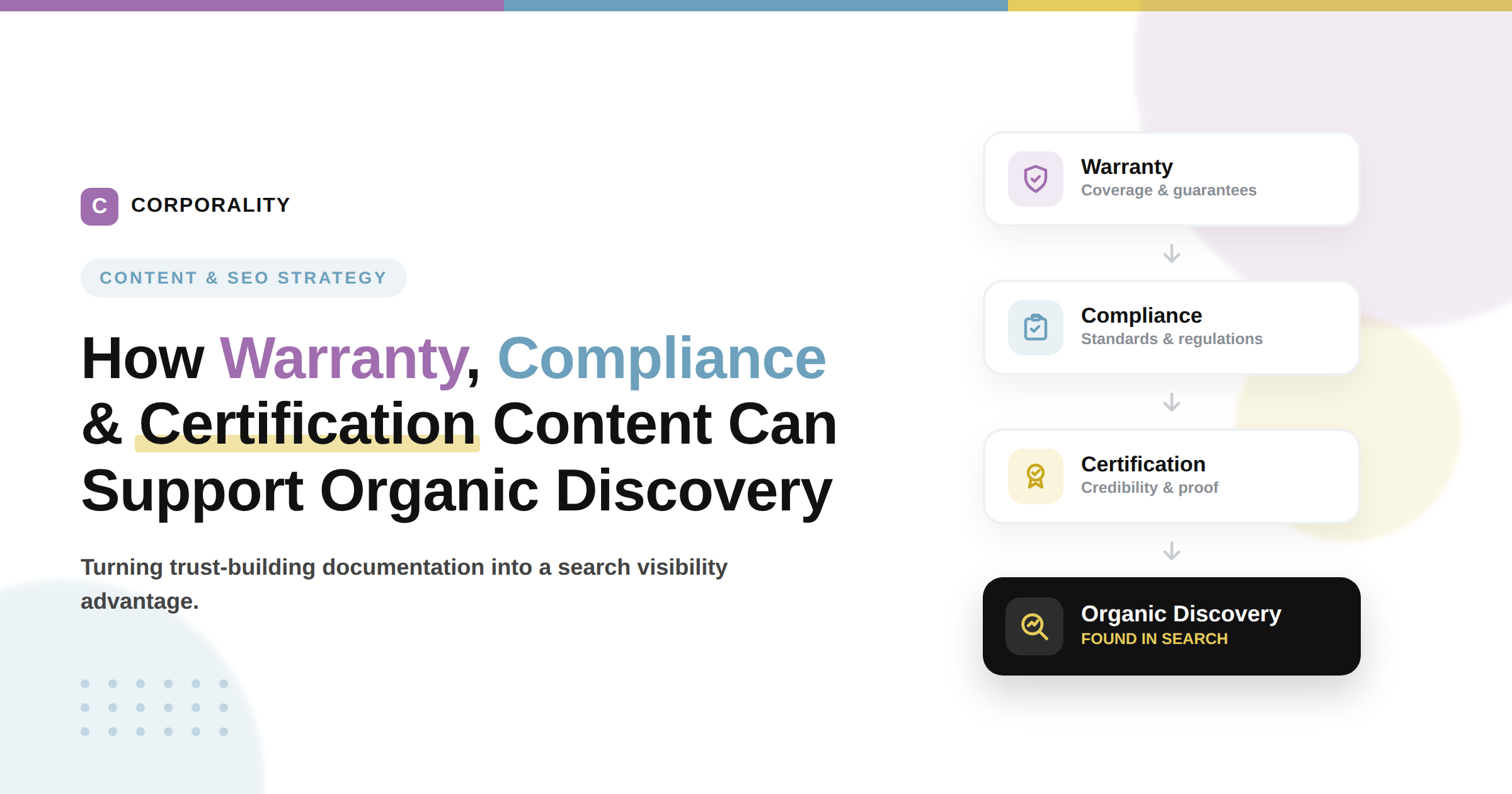
B2BHow Warranty, Compliance and Certification Content Can Support Organic Discovery
Warranty terms, certifications and compliance details are usually buried in a PDF or a footer link. Published properly, they answer high-intent questions and provide the external validation AI systems look for.
Corporality Media Team
3 February 2026
Digital PR Opportunities for Australian Manufacturing and Industrial Businesses
Digital PR is often overlooked by manufacturers, yet it offers a practical way to build authority, links and visibility. Here are the opportunities worth pursuing.
Corporality Media Team
21 October 2019
SEO Agency vs Internal SEO Team: Which Model Works for Established Businesses?
Agency, in-house team, or a blend of both? For an established business, the right SEO operating model depends on how much specialist work you need, how deep your product knowledge sits internally, and how you want accountability structured. This guide weighs the trade-offs honestly.
Corporality Media Team
22 April 2026
When Should a Growing Business Hire an SEO Agency?
There is a right time to bring in an SEO agency, and it is rarely the moment you first think about rankings. This guide sets out the practical signals that tell a growing business it has outgrown a do-it-yourself approach and is ready to invest in specialist help.
Corporality Media Team
15 April 2026
SEO ROI for Established Businesses: How to Measure Revenue, Not Rankings
Rankings are an input, not an outcome. For established businesses, the only SEO measure that matters to a board is commercial return. This guide shows how to connect organic search to revenue, pipeline and margin so you can judge the channel on the numbers that actually move the business.
Corporality Media Team
8 April 2026
How Much Should a $1M+ Business Invest in SEO in Australia?
For established Australian businesses turning over $1M or more, SEO is no longer a discretionary line item but a core commercial channel. This guide explains how to think about SEO investment as a function of revenue, margin and growth ambition, and how to set a budget that reflects your market rather than a competitor's.
Corporality Media Team
1 April 2026