Building Separate Digital Journeys for Engineers, Procurement Teams and Executives
How industrial businesses can build separate digital journeys for engineers, procurement teams and executives, aligning the website with how buyers decide.
An industrial purchase is seldom decided by one person, yet many industrial websites are built as though it were. They present a single, undifferentiated path that assumes every visitor wants the same information in the same order. In reality, the engineer, the procurement officer and the executive who together decide on a supplier each need a different journey through the site. Building those separate journeys is one of the most effective ways an industrial business can align its digital presence with the way its customers actually buy.
This article explains how to build separate digital journeys for engineers, procurement teams and executives, and why doing so improves both the experience and the outcome. It is written for industrial businesses whose buyers are technical, commercial and strategic all at once, and whose websites must serve each of these audiences well.
Why One Journey Cannot Serve Everyone
The three principal decision-makers in an industrial purchase approach the decision from fundamentally different positions. The engineer evaluates technical suitability, the procurement team assesses commercial and supply considerations, and the executive weighs strategic fit and business value. A single journey inevitably prioritises one of these perspectives and underserves the others, leaving part of the buying group unsatisfied.
The starting point for fixing this is to acknowledge that these are genuinely distinct audiences requiring distinct routes. This is fundamentally a question of structure. Understanding how to structure a website for multiple customer segments provides the foundation, because separate journeys begin with a site organised to let different visitors follow different paths rather than funnelling everyone through one.
The cost of ignoring these differences is easy to underestimate. When a website forces every visitor down the same path, each decision-maker encounters a great deal of content that is irrelevant to them before reaching what they need, if they reach it at all. The engineer wades through commercial messaging, the procurement officer sifts through technical detail, and the executive is asked to absorb specifications they will never use. Each of them works harder than they should, and each forms a subtle impression that the supplier has not quite understood them. Multiplied across a buying group, these small frustrations add up to a weaker overall case than the business is actually capable of making.
The Engineer's Journey
The engineer's journey is driven by technical validation. From the moment they arrive, an engineer is trying to confirm that a product or capability meets specific requirements. Their journey should lead quickly to detailed technical information, specifications, performance data and the evidence that establishes suitability, without forcing them through commercial or strategic content they do not yet care about.
This means the engineer's path depends on technical content being accessible and thorough. Locking specifications inside brochures or reducing them to marketing summaries frustrates this journey. Learning how to turn technical specifications into searchable commercial content ensures the engineer's journey is supported by exactly the depth of detail they need to validate their choice with confidence.
An engineer's journey also rewards a particular kind of honesty. Technical buyers are quick to detect when information has been simplified to the point of being useless, or when inconvenient limitations have been quietly omitted. A journey that presents the full technical picture, including the boundaries of what a product can do, earns more trust than one that offers only flattering highlights. The engineer is trying to make a defensible recommendation to colleagues, and a supplier that equips them to do so, rather than forcing them to seek missing detail elsewhere, becomes the natural choice to advance.
The Procurement Journey
The procurement journey is concerned with the practicalities of doing business. A procurement professional wants to understand supply reliability, commercial terms, availability and the manufacturer's dependability as a partner. Their journey should surface the information that reduces the perceived risk of committing to a supplier, and it should do so without requiring them to wade through technical detail meant for the engineer.
Supporting this journey requires the right kinds of pages, distinct from the purely technical ones. The distinction in manufacturing SEO between product, capability and industry pages is instructive here, because capability and company-level content often serves the procurement journey better than product specification pages, reassuring the buyer about the business behind the product.
Procurement journeys benefit from anticipating the questions that arise once a product has passed technical review. At that stage the conversation turns to whether the supplier can be relied upon: can it deliver on time, honour its commitments, support the product afterwards and remain a stable partner over the life of the relationship. A journey that addresses these concerns directly, with clear information rather than vague assurances, moves procurement toward approval. One that leaves the questions unanswered forces procurement to treat the supplier as an unknown quantity, which in risk-averse industrial buying is rarely to the supplier's advantage.
Want to know how your website really stacks up?
Run our free Website & AI Visibility Audit to see how you rank on Google — and in AI search results.
- Free, no-obligation report
- Delivered in minutes
- See exactly what to fix first
The Executive's Journey
The executive's journey operates at the level of business outcomes. Senior decision-makers are less interested in specifications and terms and more concerned with whether a supplier fits the strategic objective and delivers value. Their journey should lead to content that frames the offering in terms of results, applications and the broader business case, allowing them to form a judgement quickly without technical immersion.
This journey is shorter and higher-level, but no less important, because executives often hold final approval. Recognising how much of their assessment happens digitally matters, and understanding how B2B buyers find manufacturers before they contact a sales team underlines that executives, like their colleagues, form conclusions online before any conversation, making a clear executive journey essential.
Connecting the Journeys Without Merging Them
Separate journeys do not mean isolated ones. Because the three decision-makers collaborate on a single decision, their journeys must connect, allowing a visitor to move from one to another as their role in the decision requires. An engineer may need to pass the business case to an executive, or a procurement officer may need the technical validation the engineer relied on. The journeys should link naturally to support this handover.
Designing these connections is a matter of understanding the stages a buying group moves through together. The principles of designing a website around different customer buying stages apply directly, because the separate journeys are really parallel paths through a shared decision, and they should be built to converge where the decision is made rather than running entirely apart.
The executive's journey is often the shortest but the least forgiving of wasted effort. Senior decision-makers typically have little time and low tolerance for detail that does not bear on the decision they must make. A journey that quickly conveys what the supplier does, the value it delivers and the confidence others have placed in it respects that constraint. Where an executive has to dig through technical or procedural content to extract the strategic picture, the journey fails, not because the information is absent but because it is buried beneath material aimed at someone else. Surfacing the business case cleanly is what makes the executive journey effective.
Building the Journeys in Practice
Constructing separate journeys begins with mapping what each decision-maker needs and in what order. The engineer needs rapid access to technical depth; the procurement officer needs commercial reassurance; the executive needs a concise business case. Each journey is then built as a coherent path leading from entry to the information that satisfies that role, with clear signposting so visitors recognise which path is meant for them.
The work is as much about restraint as addition. A common failure is to pile every kind of information onto every page in an attempt to serve everyone at once, which produces cluttered pages that serve no one well. Separate journeys succeed by giving each decision-maker a clean path to what matters to them, hiding what does not, and trusting the connections between journeys to handle the moments when a visitor needs to cross over.
It also helps to remember that the same individual can occupy more than one role, or move between them, particularly in smaller organisations where a single person may handle technical, commercial and strategic considerations at once. Well-built journeys accommodate this by letting a visitor sample whichever path suits their current question and switch as their focus shifts. The aim is not to force people into rigid categories but to make each type of information easy to reach, so that whoever is evaluating the supplier, and in whatever capacity, can quickly find the content that answers their present concern.
Once the journeys are in place, they repay periodic review. Watching how each type of visitor actually moves through the site reveals whether the intended paths are being followed or whether people are getting lost, and it shows where a journey needs adjustment. Treating the journeys as something to refine over time, rather than a structure built once and forgotten, keeps them aligned with how the buying group really behaves.
The Payoff of Distinct Journeys
An industrial business that builds separate journeys aligns its digital presence with the reality of its market. Instead of a single path that compromises between competing needs, it offers each decision-maker an experience that respects their role and answers their questions directly. This makes the whole buying group more likely to reach a favourable conclusion, because every member finds what they need rather than a diluted version of everything.
The deeper benefit is that distinct journeys signal understanding. When an engineer, a procurement officer and an executive each find a path clearly built for them, they infer that the supplier understands how businesses like theirs actually make decisions. That impression of competence and familiarity is difficult to convey through a generic website, and it is precisely what sets apart the industrial businesses that win complex, multi-person decisions from those that struggle to be understood by any of the people making them.
Frequently Asked Questions
<p>Because the engineer, procurement officer and executive approach the decision from fundamentally different positions. A single path inevitably prioritises one perspective and underserves the others, leaving part of the buying group unsatisfied. Separate journeys give each decision-maker a route suited to their role.</p>
<p>The engineer needs rapid access to technical depth and specifications; the procurement officer needs commercial reassurance about supply and reliability; the executive needs a concise business case framed around outcomes. Each journey leads to the information that satisfies that particular role.</p>
<p>No. Because the decision-makers collaborate on a single decision, their journeys must connect so a visitor can move between them, passing a business case to an executive or sharing technical validation. The journeys are parallel paths through a shared decision that should converge where it is made.</p>
Related Content You Might Like
How to Build a Website Around the Problems Your Industrial Products Solve
Industrial buyers search by problem, not by product. Learn how to structure a website around the problems your products solve to attract qualified enquiries.
Corporality Media Team
8 July 2023
 B2B
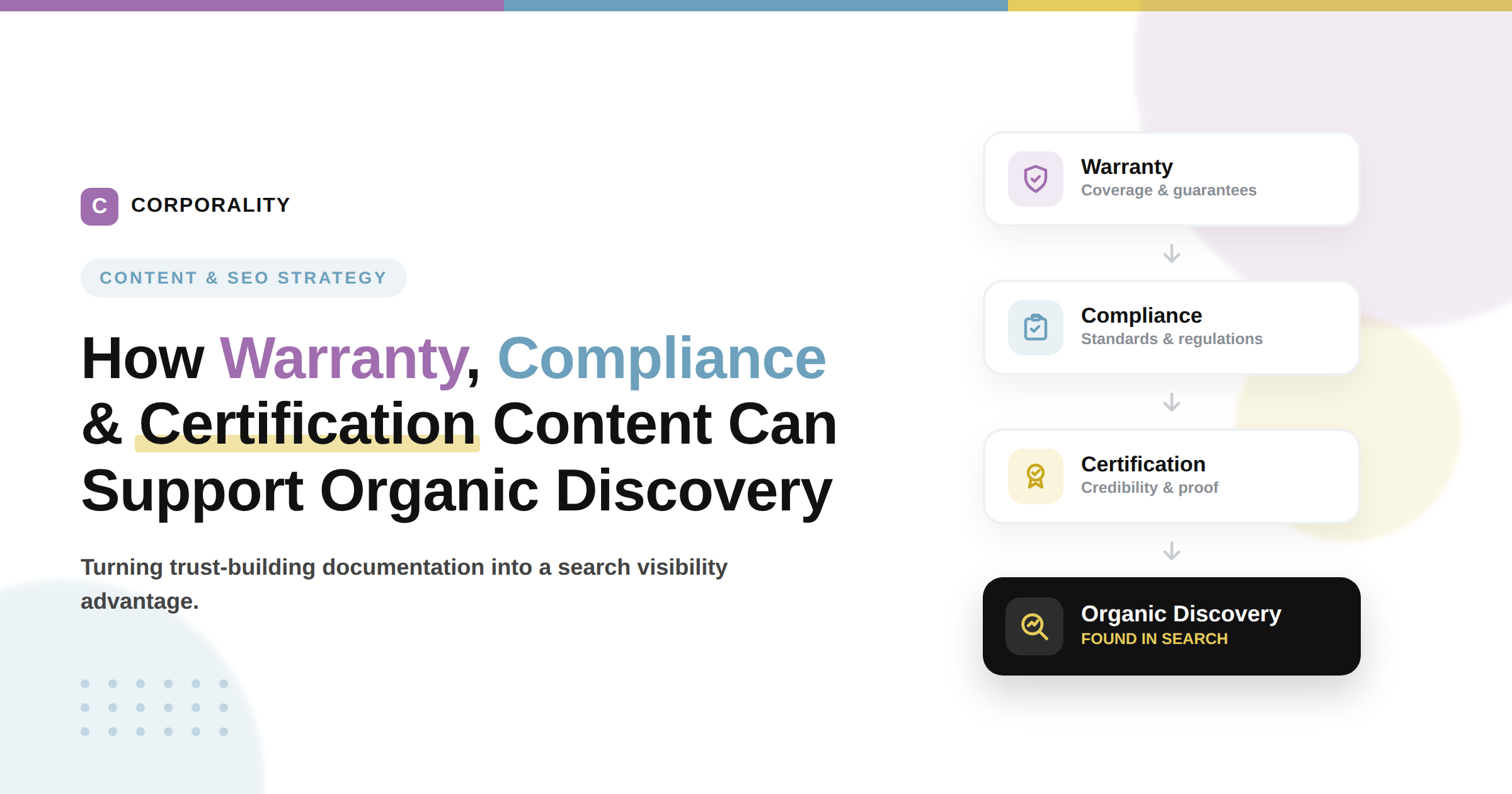
B2BHow Warranty, Compliance and Certification Content Can Support Organic Discovery
Warranty terms, certifications and compliance details are usually buried in a PDF or a footer link. Published properly, they answer high-intent questions and provide the external validation AI systems look for.
Corporality Media Team
3 February 2026
How Search Demand Changes Between Procurement, Research and Purchase
Search demand looks very different at the procurement, research and purchase stages. Learn how intent shifts across the B2B buying journey and how to respond.
Corporality Media Team
5 July 2025
How to Create a Digital Proof-of-Capability System for Industrial Buyers
Stop proving your capability one enquiry at a time. Learn how to build a digital proof-of-capability system that validates you and attracts qualified buyers.
Corporality Media Team
30 September 2023
How Industrial Buyers Use Search to Validate a Supplier Before Contacting Sales
Industrial buyers validate suppliers online before making contact. Learn what they check during this hidden stage and how to make the shortlist every time.
Corporality Media Team
2 September 2023
The Website Information Buyers Need Before Requesting a Bulk Order
A bulk order is a large commitment, and buyers gather a great deal before they ask for one. The suppliers who anticipate that homework win the enquiry.
Corporality Media Team
5 April 2023