Why Creative, Technology and Marketing Must Work Together For Growth System
Businesses often treat branding, websites, SEO and advertising as separate projects. Discover why integrating creative, technology and marketing creates sustainable business growth.
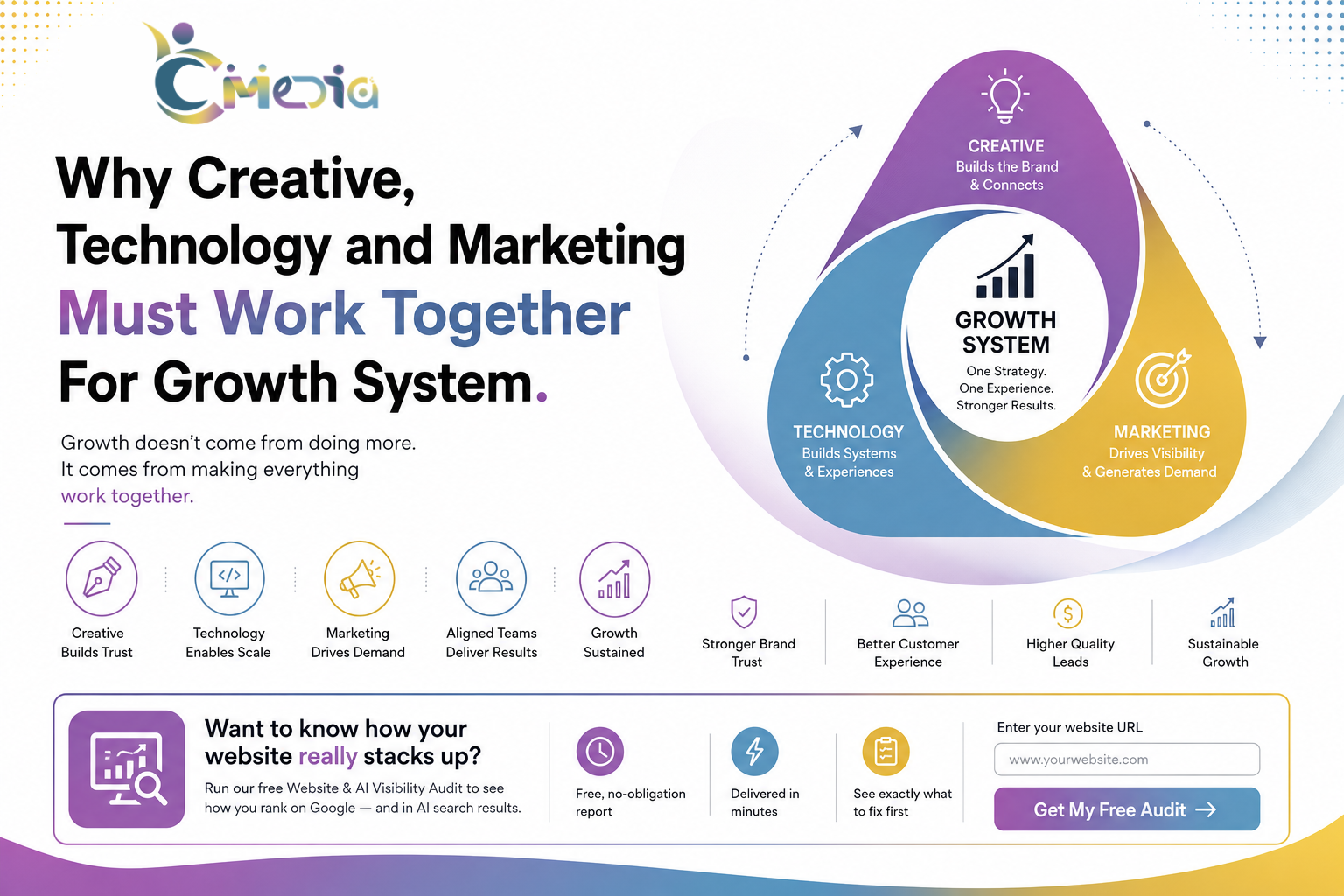
Many growing businesses invest significant time and money into improving their marketing, yet still struggle to achieve consistent commercial results.
A new logo is commissioned.
A website is redesigned.
Google Ads are launched.
Social media becomes more active.
An SEO campaign begins.
Months later, the business is left wondering why enquiries remain inconsistent, sales teams are still chasing poor-quality leads, and marketing appears disconnected from measurable business growth.
The problem often isn't the quality of any individual activity. It is that each initiative has been planned and delivered independently.
Creative teams focus on visual identity.
Developers focus on building websites.
Marketing agencies focus on campaigns.
Sales teams focus on closing opportunities.
Technology providers focus on systems and integrations.
While each discipline may perform well individually, they frequently operate without a shared commercial strategy.
Businesses do not experience growth because they have an attractive website, a memorable logo or successful advertising campaigns in isolation.
Growth occurs when every customer interaction works together to build trust, reduce friction and move prospects confidently towards a purchasing decision.
That is why creative, technology and marketing should never be treated as separate investments. They are components of a single growth system.
Marketing Is No Longer a Collection of Individual Services
For many years, businesses purchased marketing services as independent projects.
A designer created a logo.
A developer built a website.
An advertising agency managed campaigns.
Another supplier handled SEO.
Someone else managed email marketing.
Each provider completed their task before handing responsibility to the next.
While this approach was acceptable when digital channels were relatively simple, modern customer behaviour has fundamentally changed.
Today's customers rarely follow a straight purchasing journey.
Before making contact they may:
- Discover your business through Google
- Visit your website several times
- Read reviews
- Compare competitors
- Download information
- Follow your LinkedIn page
- Receive marketing emails
- Return through a remarketing campaign
- Speak with colleagues
- Visit again weeks later
Every interaction contributes to their perception of your business.
If even one stage creates confusion, uncertainty or inconsistency, trust begins to decline.
Businesses that continue treating design, technology and marketing as separate disciplines often create unnecessary friction throughout this journey.
Every Customer Experiences One Brand
Internally, organisations divide responsibilities into departments.
Marketing manages campaigns.
Design creates visual assets.
IT manages systems.
Sales follows up enquiries.
Operations deliver services.
Customers, however, never experience departments.
They experience one business.
When a potential customer visits your website, they are not evaluating whether your developer used the latest framework or whether your graphic designer selected the correct typography.
They are asking much simpler questions.
Can I trust this business?
Do they understand my industry?
Can they solve my problem?
Will working with them be easy?
Every touchpoint either reinforces confidence or creates uncertainty.
That experience is influenced by far more than visual design.
It includes:
- Brand positioning
- Website performance
- User experience
- Content quality
- Search visibility
- Page speed
- Navigation
- Calls-to-action
- Lead forms
- Email responses
- Sales communication
- Follow-up automation
Customers do not separate these experiences.
Neither should businesses.
The Hidden Cost of Fragmented Marketing
Many organisations unknowingly invest in disconnected marketing activities.
The website is managed by one supplier.
Branding by another.
SEO by another.
Advertising by another.
CRM by another.
Content by another.
Every provider submits monthly reports showing their own success.
The advertising agency celebrates lower cost-per-click.
The SEO consultant highlights ranking improvements.
The designer showcases attractive creative work.
The developer reports successful deployments.
Despite these positive reports, management continues asking one question:
Why isn't revenue growing at the same pace as marketing investment?
The answer often lies between departments rather than inside them.
Disconnected marketing creates problems that rarely appear in individual reports.
For example:
A Google Ads campaign may generate excellent traffic, but visitors arrive on a confusing website.
The website may convert well, but sales enquiries receive inconsistent follow-up.
Brand messaging may promise premium quality while visual identity suggests low-cost services.
Excellent SEO may attract visitors searching for information rather than commercial solutions.
Marketing automation may nurture leads effectively while outdated branding reduces credibility.
Each component performs reasonably well.
The overall business system does not.
Want to know how your website really stacks up?
Run our free Website & AI Visibility Audit to see how you rank on Google — and in AI search results.
- Free, no-obligation report
- Delivered in minutes
- See exactly what to fix first
Business Growth Depends on Connected Decisions
One of the biggest misconceptions in marketing is believing that individual tactics create sustainable growth.
In reality, commercial growth is usually the result of multiple connected decisions.
Consider a manufacturing company launching a new product.
A successful launch involves much more than publishing a webpage.
The business requires:
- Product positioning
- Technical content
- Professional photography
- Website landing pages
- Sales collateral
- Email announcements
- Distributor communications
- Search optimisation
- Paid advertising
- CRM integration
- Lead tracking
- Follow-up workflows
Removing any one component weakens the entire customer journey.
The same principle applies across every industry.
A luxury retreat depends on branding, photography, booking experience, SEO and email marketing working together.
A medical centre relies on trust, accessibility, patient journeys, local search visibility and efficient enquiry handling.
A premium pet brand requires packaging, ecommerce, product education, paid advertising and customer retention campaigns to operate as a single commercial ecosystem.
Growth is rarely created by one exceptional activity.
It is created when many good activities reinforce one another.
The Five Pillars of an Integrated Growth System
Businesses that consistently outperform competitors usually connect five essential disciplines.
1. Brand Strategy
Branding defines perception before customers engage with your business.
It establishes:
- Positioning
- Trust
- Credibility
- Differentiation
- Personality
- Commercial value
Without strategic branding, marketing becomes significantly more difficult because every campaign starts by overcoming uncertainty.
2. Digital Experience
Websites, landing pages and user experience determine whether interest becomes action.
Digital experience should reduce friction rather than create it.
Every page should answer important customer questions while guiding visitors naturally towards the next step.
Good websites are not simply attractive.
They are commercially effective.
Related Content You Might Like
The Digital Strategy for Repositioning an Established Product
Repositioning an established product online is delicate work. Learn the digital strategy that shifts perception without losing existing demand.
Corporality Media Team
13 September 2022
Why Industry Specialisation Can Improve Digital Marketing Performance
Industry specialisation is not a limit on B2B digital marketing — it is one of the most reliable ways to improve message clarity, search demand and lead quality.
Corporality Media Team
2 May 2020
How to Turn Technical Specifications Into Searchable Commercial Content
Specification sheets hold the answers buyers search for. Learn how to turn technical data into readable, searchable commercial content that generates enquiries.
Corporality Media Team
16 August 2025
How to Build a Sustainable Online Demand Engine Around Your Product Portfolio
Individual campaigns fade. Learn how to build a sustainable online demand engine around your product portfolio that keeps generating enquiries.
Corporality Media Team
20 September 2022
How to Explain Product Improvements Without Confusing Existing Customers
Product improvements can unsettle loyal customers if handled poorly. Learn how to explain them clearly without causing confusion.
Corporality Media Team
6 September 2022
Why Product Version Changes Need a Digital Communication Strategy
A new product version affects customers and search alike. Learn why version changes need a clear digital communication strategy.
Corporality Media Team
30 August 2022