How Australian Businesses Can Optimise for AI Search and Generative Engine Optimisation (GEO)
A practical 2026 guide to improving AI search visibility, building digital authority and helping Australian businesses become easier for AI systems to understand and recommend.
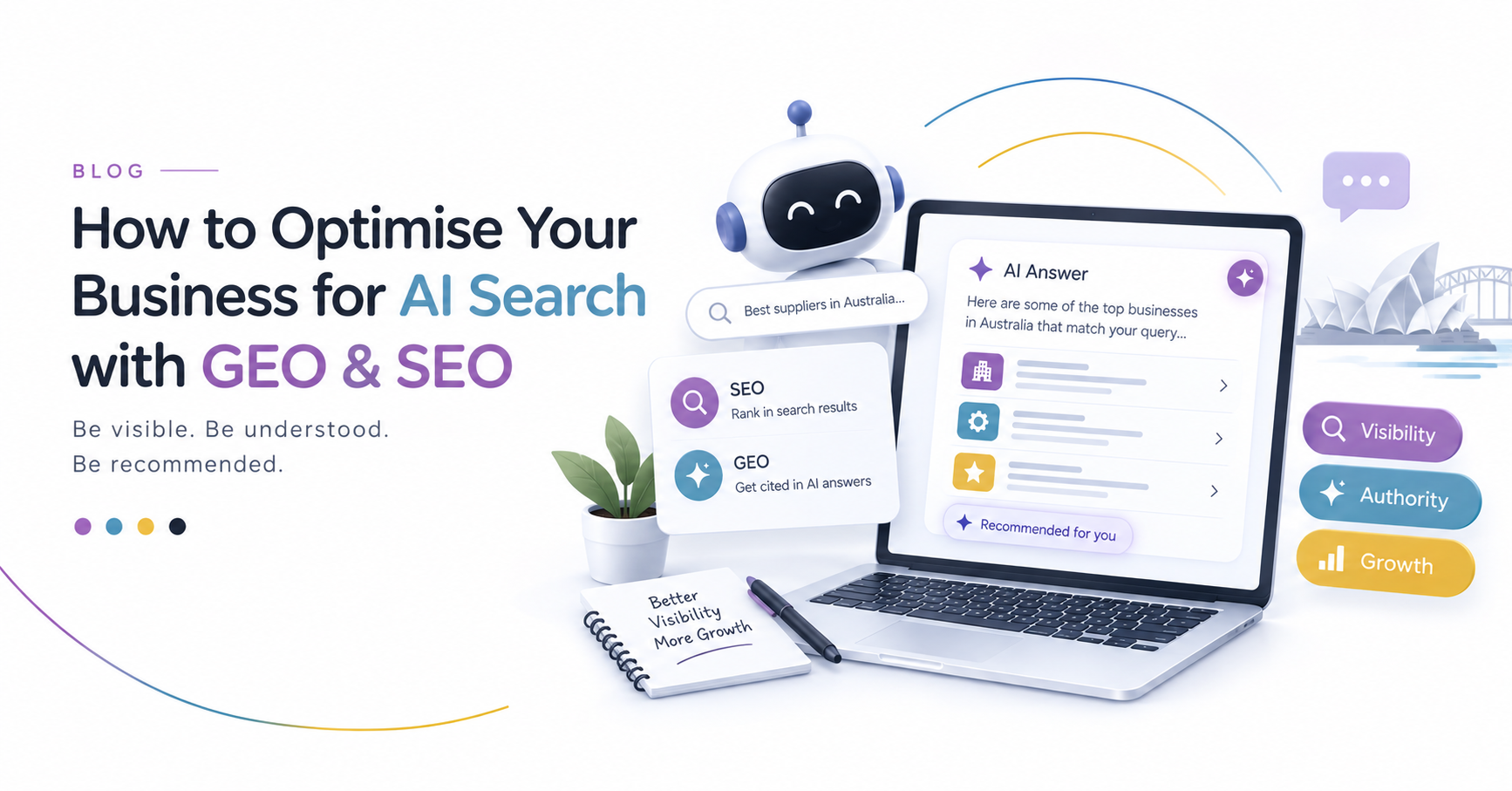
AI search is changing how Australian buyers discover businesses, research suppliers and compare their options. Instead of working through a long list of traditional search results, a buyer can now ask an AI system a detailed question and receive a direct answer, shortlist or recommendation.
For Australian businesses, this creates a new visibility challenge. Ranking well in Google remains important, but it is no longer the only measure of search performance. Your business also needs to be clearly understood across AI-driven discovery environments.
This is where Generative Engine Optimisation (GEO) becomes relevant. GEO is the practice of improving how clearly and credibly a business, its expertise, products and services are represented so AI-powered search systems can understand, reference and potentially recommend them.
The goal is not to chase an algorithm or find a secret prompt that guarantees an AI recommendation. The practical approach is much more straightforward: make your business easier to understand, support your claims with evidence, answer genuine buyer questions and build a strong digital presence across the places AI systems may use when forming an answer.
What Is Generative Engine Optimisation?
Generative Engine Optimisation is focused on visibility within AI-generated answers rather than only traditional search rankings.
Traditional SEO helps search engines understand and rank web pages. GEO extends that thinking to environments where an AI system may interpret a question, combine information from multiple sources and produce a conversational response.
For example, a buyer might search Google for industrial packaging suppliers in Western Sydney. They may then ask an AI assistant which suppliers are suitable for a particular application, what capabilities they offer or which businesses serve a particular region.
Those are different search experiences. The first is primarily about ranking. The second is about whether the AI can understand which businesses are relevant to the question and has enough reliable information to include them in its answer.
GEO therefore should not be treated as a replacement for SEO. Australian businesses need both. The same fundamentals — useful content, technical accessibility, authority, clear business information and strong user experience — support visibility across both traditional and AI-driven search.
Why AI Search Matters for Australian Businesses in 2026
Search behaviour is becoming more conversational and research-driven. Buyers can use AI tools to explore suppliers, understand technical subjects, compare options and refine purchasing decisions before contacting a business.
This is particularly relevant to B2B businesses. A manufacturer, distributor, professional service firm or specialist supplier may have years of knowledge inside its organisation, but that expertise has limited search value if it remains hidden inside sales conversations, PDFs or internal documents.
AI search creates an incentive to bring that knowledge into accessible digital content.
For established Australian businesses, the opportunity is not simply to publish more pages. It is to make the information that differentiates the business easier for search systems and buyers to find, understand and verify.
1. Make Your Business Identity Clear
AI systems need to establish basic facts before they can confidently connect your business with a buyer's question.
Your website should make it immediately clear:
- Who your business is
- What products or services you provide
- Which industries you serve
- Where you operate
- Who your ideal customers are
- What makes your expertise different
- Which problems your products or services solve
This information should not exist only on your homepage. Important relationships should be reinforced throughout relevant service, product, industry, location and case study pages.
For example, if an Australian manufacturer serves food production businesses across New South Wales, that relationship should be clearly represented in relevant content rather than left for an AI system to infer.
2. Turn Business Expertise Into Searchable Content
One of the biggest GEO opportunities for established businesses is often already sitting inside the organisation.
Your sales team knows what customers ask. Your technical team knows what causes problems. Your operations team understands delivery requirements. Your customer service team knows the objections and concerns that appear repeatedly.
That knowledge can become highly valuable content.
Instead of publishing generic articles such as Why Choose Our Company?, create useful resources that answer specific commercial questions.
Examples include:
- What specifications should buyers consider before choosing this type of equipment?
- Which industries can use this solution?
- What is the difference between two common product options?
- What are the limitations of this service?
- How long does implementation normally take?
- What should businesses prepare before requesting a quote?
Specific expertise gives your website something valuable to say. It also creates information that is more useful to buyers than generic marketing copy.
3. Create Direct Answers to Real Buyer Questions
AI search is fundamentally question-driven. Your content should reflect that behaviour.
Identify the questions customers ask before, during and after the buying process. Then create clear answers that can stand on their own.
Start the answer directly rather than spending several paragraphs building towards it. Explain the relevant conditions, exceptions and practical details afterwards.
This structure helps human readers scan information quickly while making individual answers easier for automated systems to interpret.
Do not create questions simply because they contain a keyword. Use real questions from customers, sales conversations, support enquiries, search behaviour and industry discussions.
4. Build Evidence Into Your Content
Strong claims need support.
If your business says it has specialist expertise, demonstrate that expertise. If you claim experience in a particular industry, show relevant projects, applications or examples. If you make technical claims, explain the specifications or conditions behind them.
Useful evidence can include:
- Original company data
- Technical specifications
- Project examples
- Case studies
- Customer outcomes
- Industry experience
- Expert commentary
- Processes and methodologies
- Clear service or product limitations
The objective is not to decorate a page with impressive-sounding statements. It is to give buyers and search systems something concrete to assess.
5. Make Technical Information Accessible
Many Australian B2B businesses have valuable information trapped inside downloadable brochures, specification sheets or sales presentations.
Those resources can still be useful, but important information should also appear as readable website content.
If a product has specific operating conditions, applications, compatibility requirements or technical specifications, explain those details on the relevant web page.
This creates a stronger information source for buyers and gives search systems clearer material to interpret.
Want to know how your website really stacks up?
Run our free Website & AI Visibility Audit to see how you rank on Google — and in AI search results.
- Free, no-obligation report
- Delivered in minutes
- See exactly what to fix first
6. Strengthen Your Website Structure
GEO is not just a content exercise. Website structure matters because information needs to be discoverable and logically connected.
Organise your website so the relationships between your business, services, products, industries and locations are obvious.
A strong structure might connect:
| Business Information | Supporting Content |
|---|---|
| Service | Service details, FAQs, case studies and supporting guides |
| Product | Specifications, applications, comparisons and technical information |
| Industry | Industry problems, solutions, examples and expertise |
| Location | Genuine regional capability, projects and service coverage |
This structure helps create a consistent picture of the business rather than a collection of disconnected pages.
7. Use Internal Links to Connect Expertise
Internal linking is particularly important when building an AI-ready website.
A useful article should lead readers towards relevant services, products and supporting resources. A service page should connect to useful educational content. A case study should reinforce the service and industry it relates to.
These connections help users navigate the website and provide additional context about how different parts of the business relate to one another.
For Australian businesses with complex service portfolios, this can be particularly valuable. Clear relationships reduce ambiguity and make the website easier to understand.
8. Optimise for SEO, AEO and GEO Together
Businesses should avoid treating SEO, Answer Engine Optimisation and GEO as completely separate marketing projects.
There is significant overlap.
- SEO focuses on visibility within traditional search engines.
- AEO focuses on providing direct answers to search questions.
- GEO focuses on visibility within generative and AI-driven search experiences.
A well-written, technically sound page can support all three objectives.
The practical strategy is therefore to create content that satisfies people first while being structured clearly enough for search engines and AI systems to interpret.
9. Avoid Mass-Producing Generic AI Content
AI tools can accelerate content production, but publishing large volumes of generic material is not a GEO strategy.
Australian businesses should be particularly careful about producing pages that simply repeat information already available across hundreds of competing websites.
Instead, use AI tools to support research, outlining, editing and content workflows while adding genuine business knowledge, evidence and expert insight.
Your competitive advantage is not access to the same writing tool as everyone else. It is the information, experience and expertise that your business can contribute.
10. Measure AI Visibility as Well as Rankings
Traditional SEO reporting often focuses on rankings, organic traffic and conversions. These remain useful, but AI search introduces additional questions.
For example:
- Does AI search understand what your business does?
- Is your business mentioned for relevant buyer questions?
- Are competitors being recommended when your business should be considered?
- Does AI describe your services accurately?
- Are your strongest areas of expertise visible online?
Testing realistic buyer questions can reveal gaps that conventional ranking reports may not show.
The objective is not to chase every AI mention. The commercial objective is to become easier to discover and understand for the questions that matter to your business.
A Practical GEO Checklist for Australian Businesses
Before investing heavily in a new AI search strategy, review the foundations already available on your website.
- Clearly explain who your business serves.
- Define your products and services in straightforward language.
- Document genuine industry expertise.
- Answer real customer questions.
- Publish original information where appropriate.
- Support important claims with evidence.
- Move valuable technical information into accessible web content.
- Build logical internal links between related pages.
- Strengthen relevant service, industry and location pages.
- Review how AI systems currently describe your business.
- Measure qualified enquiries rather than content volume alone.
The Future of Search Is Not Just About Rankings
AI search does not make traditional SEO irrelevant. It changes the definition of digital visibility.
Australian businesses now need to consider whether they are not only searchable, but also understandable, credible and relevant when a buyer asks a more complex question.
That requires more than publishing content for keywords. It requires a clear business identity, useful information, evidence, technical accessibility and a website structure that connects expertise with buyer needs.
For established B2B businesses, this can be a significant advantage. Years of technical knowledge, customer experience and industry expertise can become digital assets when they are documented properly.
The businesses best positioned for AI search are unlikely to be those that simply publish the most content. They will be the businesses that make their expertise easiest to understand and their claims easiest to trust.
If your website already performs well in traditional search, GEO should be viewed as an extension of that foundation rather than a separate replacement strategy. A combined SEO, AEO and GEO approach gives Australian businesses a more resilient way to remain visible as search continues to evolve.
Frequently Asked Questions
<p>Generative Engine Optimisation (GEO) is the practice of improving a business's visibility within AI-generated search results and recommendations. It focuses on making a company's identity, expertise, products, services and supporting evidence clear and easy for AI systems to interpret.</p>
<p>No. GEO does not replace SEO. Traditional search remains important, while AI-powered search introduces additional discovery and recommendation surfaces. A strong strategy combines SEO, AEO and GEO because they share many of the same foundations, including useful content, clear structure, technical accessibility and credible information.</p>
<p>Start by clearly explaining what the business does, who it serves and where it operates. Then publish genuine expertise, answer real buyer questions, provide evidence for important claims, make technical information accessible and connect related content through a logical website structure. Regularly testing relevant AI search queries can also reveal visibility and accuracy gaps.</p>
Related Content You Might Like
 Business Marketing
How AI Search Is Changing the Way Australian Businesses Market Themselves in 2026
AI search is changing how Australian buyers discover, compare and choose businesses, making search visibility about more than traditional Google rankings.
Corporality Media Team
25 August 2026
SEO vs GEO: What Established Australian Businesses Actually Need
SEO and GEO are not competing choices. Here is what established Australian B2B businesses actually need from both traditional and AI-driven search, without the hype.
Corporality Media
19 March 2026
Why AI Search Engines May Understand Your Competitor Better Than Your Business
If AI assistants describe your competitor clearly but struggle with your business, the cause is usually structural. Here is why, and how to fix it.
Corporality Media
2 April 2026
Can ChatGPT Find Your Business? A Practical Test for Western Sydney Companies
A simple, practical test to check whether AI assistants like ChatGPT can actually find and recommend your Western Sydney business, and what to do if they cannot.
Corporality Media
12 March 2026
The GA4 Reports That Matter Most to Manufacturing and Distribution Businesses
Most GA4 dashboards overwhelm manufacturers and distributors with vanity metrics. Here are the GA4 reports that actually reveal enquiry quality, buyer intent and commercial demand.
Corporality Media
17 June 2024
 Business Marketing
How to Select the Right Audience for a Promotional Campaign
Audience selection quietly determines most of your campaign result. Here is a practical way to choose the group most likely to respond, and to leave the rest alone.
Corporality Media Team
31 August 2019